


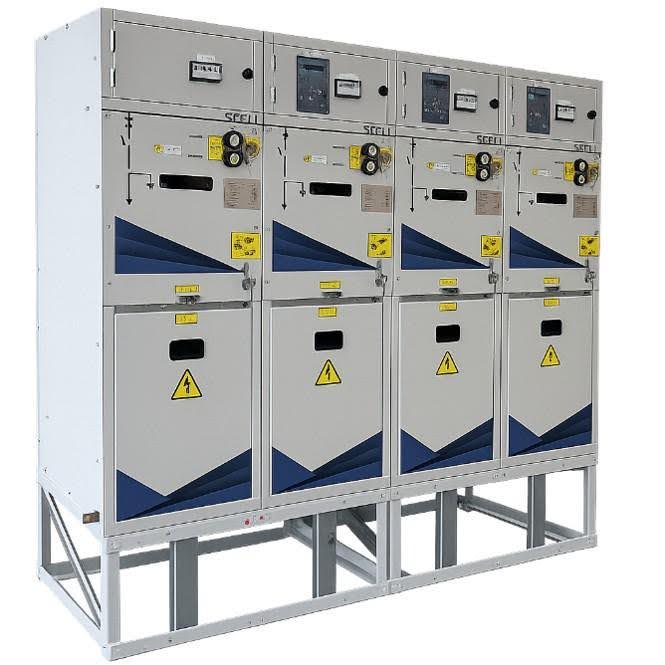
For decades, sulfur hexafluoride (SF6) has been widely used in electrical switchgear because of its excellent insulating and arc-quenching properties. But its extremely high global warming potential (GWP) has made finding alternatives an environmental and regulatory priority.
As we explored in our previous blog on the phasing out of fluorinated gases, new regulations are accelerating that transition. In the EU, the use of F-gases in new switchgear up to 24kV was prohibited from 1 January 2026, with restrictions extending to higher voltage classes over the coming years.
Fortunately, manufacturers now have several technologies at their disposal. But what are the main SF6-free alternatives, and what are their respective benefits, drawbacks and applications?
Can alternative gases replace SF6?
One approach is to retain the compact, sealed architecture of gas-insulated switchgear (GIS) while replacing SF6 with an alternative insulating gas.
Options include fluoronitrile- and fluoroketone-based mixtures, typically combined with carrier gases such as carbon dioxide, oxygen or nitrogen. These can provide strong dielectric performance with a substantially lower GWP than SF6, enabling manufacturers to retain many of the space-saving advantages of GIS.
Other systems use CO2 or CO2-containing mixtures, while clean or dry air – typically composed of nitrogen and oxygen – is another option. Air has the particular environmental advantage of avoiding fluorinated greenhouse gases altogether.
Alternative-gas GIS can be especially useful where space is restricted and a compact, enclosed design is required. However, gas-based solutions can still require sealed enclosures, pressure management and specialised handling procedures. Some alternative gas mixtures also retain a GWP, even if dramatically lower than that of SF6.
What about solid insulation and vacuum technology?
eliminate reliance on insulating gases altogether.
Solid-insulated switchgear uses dielectric materials such as epoxy resin to encapsulate and electrically isolate live components. Its high dielectric strength enables compact designs and removes the risk of insulating-gas leakage. However, greater use of solid materials introduces other considerations, including manufacturing complexity and the treatment or recycling of materials at the end of the equipment’s life.
Vacuum technology performs a different role. In a vacuum circuit breaker (VCB), contacts open within a sealed vacuum interrupter, where the electrical arc is extinguished rapidly during switching or fault interruption.
Importantly, this does not necessarily mean that the entire switchgear assembly is ‘vacuum insulated’. In many modern medium-voltage systems, a vacuum is used for interruption within the circuit breaker while air or another dielectric provides insulation elsewhere in the switchgear.
Vacuum interruption is particularly well established at medium voltage, offering long operating life, high switching endurance and minimal maintenance without the need to handle insulating gas.
How do hybrid SF6-free solutions work?
In practice, the boundaries between these categories are not always clear-cut. Many modern SF6-free systems combine technologies to exploit their respective strengths.
One increasingly common approach pairs vacuum interruption with clean or dry air insulation. Here, the vacuum interrupter handles the demanding task of extinguishing the arc, while air provides electrical insulation between other live components and earth.
Other hybrid designs combine vacuum interrupters with alternative gas mixtures or solid insulation. This gives manufacturers flexibility to balance factors such as footprint, voltage rating, environmental impact, maintenance requirements and cost.
There is no single technology that will replace SF6 in every application. The optimum solution depends on the requirements of the network and installation.
Why does TE Energy combine air insulation with vacuum interruption?
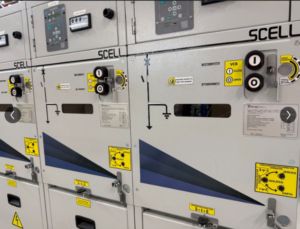 At TE Energy, we’ve specialised in SF6-free vacuum switching technologies for many years. For medium-voltage applications, combining proven air insulation with vacuum circuit breakers provides a straightforward way to eliminate SF6 while maintaining reliability, safety and performance.
Our SCELL range demonstrates how far this approach has evolved. Designed for primary and secondary distribution up to 24kV, SCELL combines a compact air-insulated architecture with VCBs rated for up to 30,000 close-open operations. Its compact dimensions make it suitable for applications where space efficiency is important, without requiring an SF6-filled enclosure.
Our MILE range applies the same principles to demanding utility and industrial applications. The SG40 MILE extends our SF6-free air-insulated range to 36kV, combining air insulation with removable VCBs to support straightforward inspection and maintenance.
 The benefits extend across the equipment lifecycle. TE Energy’s air-insulated systems require no gas-pressure monitoring or periodic tank tightness checks, while vacuum circuit breakers are designed for minimal maintenance. Avoiding SF6 can also simplify end-of-life handling and decommissioning.
Different applications will continue to call for different technologies. But as the electrical industry moves away from fluorinated gases, proven combinations such as air insulation and vacuum interruption demonstrate that sustainability need not come at the expense of reliability or performance.